As agencies move into FY26, leaders are re-evaluating how to maximize every dollar while maintaining performance. Budget resets bring opportunity, but they also increase pressure to deliver results under tighter constraints. At the start of the fiscal year, process assessments offer a critical pause to review what worked, what didn’t, and what needs to evolve.
At Thompson Gray, process optimization is a form of preventive maintenance. It protects both operational readiness and return on taxpayer investment. This work matters not just because it saves money, but because it strengthens the systems that sustain mission delivery.
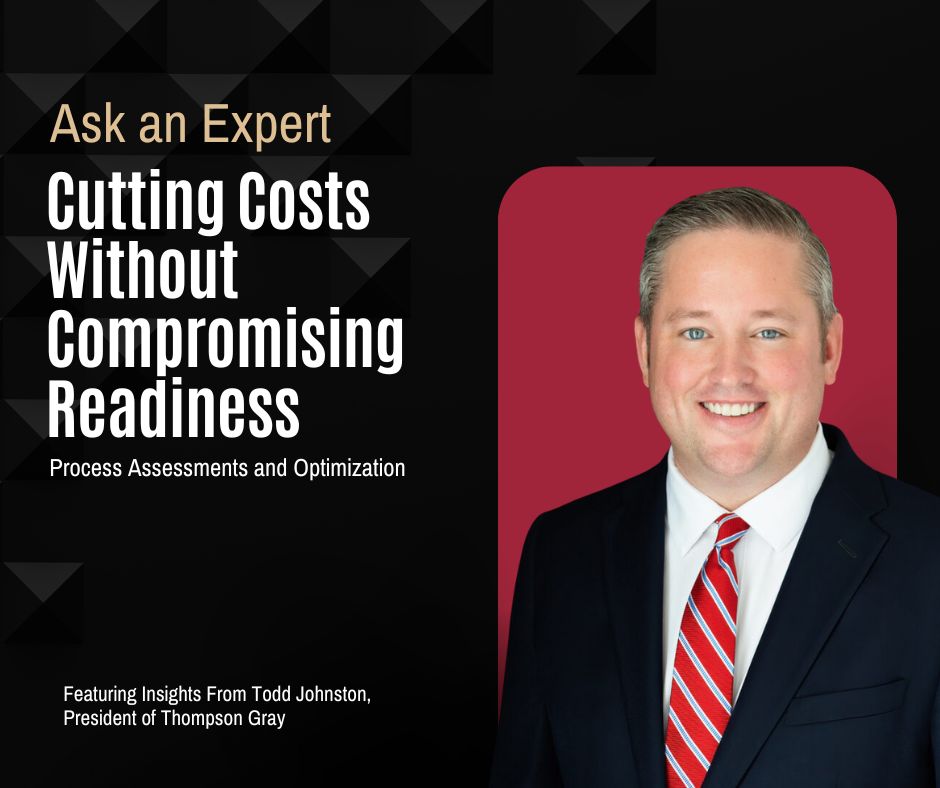
We asked Todd Johnston, President of Thompson Gray, to share his insights on how process assessments create lasting impact and what agencies should consider as they improve efficiency across operations.
Why the Start of the Fiscal Year Is the Right Time to Assess
Johnston noted that “the new fiscal year is where optimism meets reality.” New funding cycles often come with shifting priorities and fewer resources. A structured process assessment ensures agencies avoid carrying forward inefficiencies from the previous year.
“It’s the pause between execution cycles that lets leaders separate noise from signal — what worked, what didn’t, and what must evolve,” he said. “At Thompson Gray, we view it as preventive maintenance for the enterprise: inspect the systems, validate decision rights, and realign processes before funding starts flowing.”
Fixing What Slows the Mission
Three inefficiencies tend to repeat across missions and agencies:
- Redundant data calls and manual reconciliations
- Ambiguous decision rights
- Disconnected planning and execution
He explained that “automating those linkages frees up scarce analytic bandwidth,” while “clarity costs nothing and saves millions in rework.” When budgeting, contracting, and operations are out of sync, aligning those processes can transform planning into a continuous, responsive effort rather than a once-a-year activity.
The real value comes from distinguishing between cost-cutting and capability erosion. “True efficiency preserves capability while eliminating friction,” Johnston said. That begins with mapping costs to mission outcomes rather than accounting lines.
What Optimization Looks Like in Practice
When Thompson Gray supports a process assessment, the first step is to establish clarity. That includes defining ownership, process objectives, and performance metrics. “From there, we trace how work actually moves through the system — people, data, and decisions — and compare that reality to how it’s supposed to work,” said Johnston.
The team then removes unnecessary steps, realigns decision points, and embeds controls so compliance happens as part of the work. The approach is simple by design: “make the process visible, measure what matters, and fix what breaks the flow.”
Johnston cautioned that many teams focus on fixing what is without asking what should be. “That’s why I say ‘deliberately simple.’ The deliberate part matters. Without it, you get lost in the noise — busy, reactive, and mistaking activity for progress — instead of building real solutions.”
Customer Example:
One Army customer was tracking reimbursable employees and associated funding through multiple disconnected systems. Analysts relied on personal spreadsheets, which led to duplication, siloed data, and increased risk of error.
Thompson Gray helped replace the process with a Microsoft-based tool that connected directly to manpower data, TDA structures, support agreements, and execution systems. The solution provided an on-demand view of reimbursable positions and funding alignment across the fiscal year.
“The impact was immediate,” Johnston said. “The tool automated data comparison, eliminated redundant manual tracking, and gave the team a common operating picture.” The customer now makes faster, more accurate decisions, while analysts can focus on forecasting and execution instead of reconciliation.
Building Trust in the Process
Every TG recommendation is tested through three filters: mission impact, compliance integrity, and operational feasibility. Johnston said this “keeps recommendations practical and credible,” and ensures agencies never have to choose between performance and auditability.
The Role of Technology and Data
Dashboards and automation are helping agencies move from opinion-based decision-making to evidence-based action. Johnston explained that dashboards “translate complex operations into measurable trends, so leaders can see, daily, where bottlenecks form and where interventions work.”
“Technology is an amplifier, not a substitute for discipline,” he added. “The goal isn’t more technology; it’s smarter execution.”
Embedding Change Management from the Start
Even the most well-designed process can fail without buy-in. Thompson Gray integrates change management early, including user feedback and quick wins that show immediate benefit. “When people understand the purpose and see the payoff, resistance turns into ownership,” Johnston said.
Advice for Leaders: Start with Clarity
When asked what advice he would give to agencies starting a process assessment, Johnston was clear: “Start with clarity. You can’t fix what you haven’t defined.”
Map the current state exactly as it is, with no blame, and then design the ideal state. “Most process assessments fail because people skip straight to solutions. They start designing the future before they understand the present.”
Looking Ahead: Optimization as Strategic Capability
Johnston is a firm believer that the future of process improvement in government is promising. “What excites me most is that process improvement is evolving from a compliance exercise into a genuine strategic capability,” he said.
“When an agency can deliver faster, cleaner, and with greater accountability because its internal systems are optimized, that strengthens the entire enterprise.”