When new functionality is released every two weeks, legacy training models no longer work. The ADDIE model, once the gold standard for training in defense and federal environments, was built for predictability—not speed.
Today’s Agile development cycles, continuous integration, and DEV/SEC/OPS practices have changed the landscape. Systems evolve quickly. Interfaces shift. Workflows adjust. Traditional training timelines are no longer sufficient, and users are often left behind.
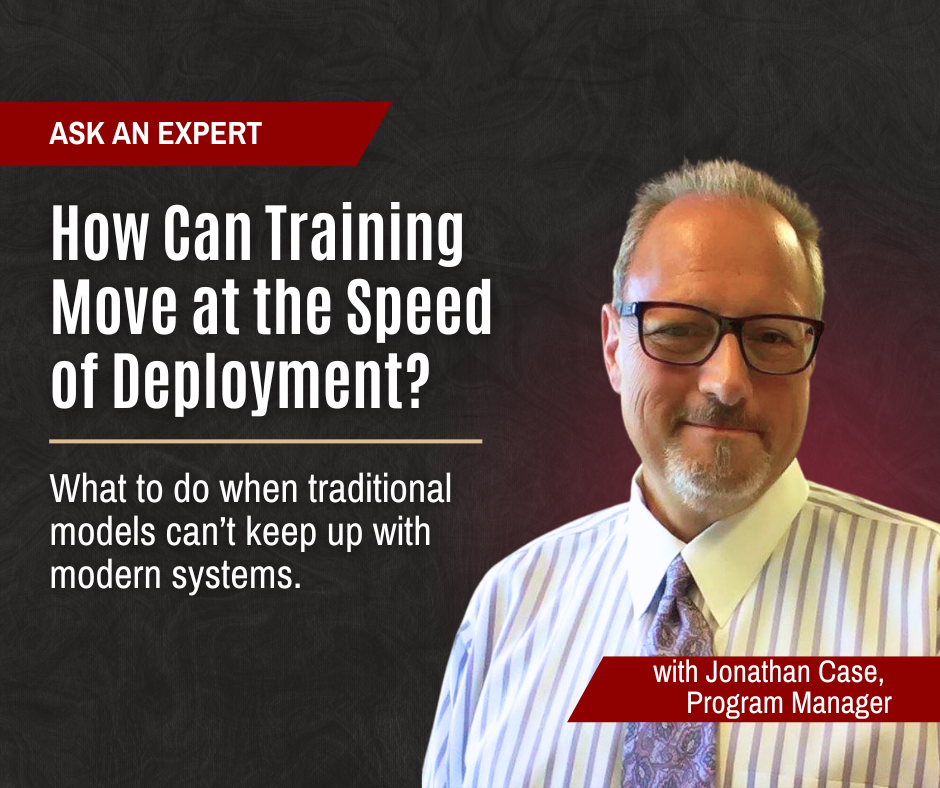
“The traditional ADDIE model gave us discipline and structure,” says Jonathan Case, a Program Manager at Thompson Gray. “But in an Agile ERP environment, that five-step equation breaks down. What once added up now creates a readiness gap.”
Why Traditional Training Falls Short
Modern ERP systems move fast. Release cycles are short, changes are constant, and user interfaces evolve regularly. Yet many training programs still operate at the pace of months or quarters.
This mismatch creates a performance gap. Users receive new tools faster than they receive guidance to use them effectively.
Here’s where the ADDIE model struggles:
- Analysis lags behind. By the time needs assessments are completed, new features are already live.
- Design stays static. Templates are built for classroom or web-based training, not evolving systems.
- Development cannot keep up. Multimedia assets take weeks to build, but new releases happen in days.
- Implementation misses the window. Training sessions often arrive too late to be useful.
- Evaluation loses relevance. Feedback cycles are slow, and often outdated by the time they’re applied.
In high-stakes environments like defense and federal ERP programs, this lag isn’t just inefficient. It threatens mission readiness.
What LearningOps Looks Like
To close the gap, leading agencies are adopting a LearningOps approach. Training is no longer an afterthought. It becomes part of the software development process.
“We don’t build courses to sit on a shelf,” Jonathan explains. “We build training that evolves with the software. It lives inside the development cycle.”
This shift includes:
- Versioning training content with code releases
- Replacing static design documents with Agile learning backlogs
- Using embedded help and task-based job aids instead of large-scale courses
- Delivering content that is accessible, relevant, and available in real time
At Thompson Gray, training professionals work directly with developers, functional experts, and end users. This integration ensures that what people learn matches what the system actually does.
Why It Matters
In a modern ERP environment, working software is only part of the mission. The real question is whether users can perform their tasks effectively, securely, and confidently from day one.
When training is delayed or deprioritized, even a well-built system can underperform. That’s why enabling users is just as important as deploying code.
“You can’t treat training like a checkbox,” Jonathan says. “If users aren’t ready, the mission isn’t ready. It’s that simple.”
A Smarter Approach to ERP Training
Organizations that continue to rely on traditional models will always fall behind. Success now depends on learning practices that move with the system, not after it.
By embedding training into the development cycle and prioritizing user readiness as part of every release, agencies can improve performance, reduce rework, and protect mission continuity.
Thompson Gray helps our customers treat training as a continuous asset, not a one-time product. Because in today’s ERP environment, software alone is not enough. Empowered users complete the mission.
Learn more about our Program Management Support and Digital Transformation capabilities.