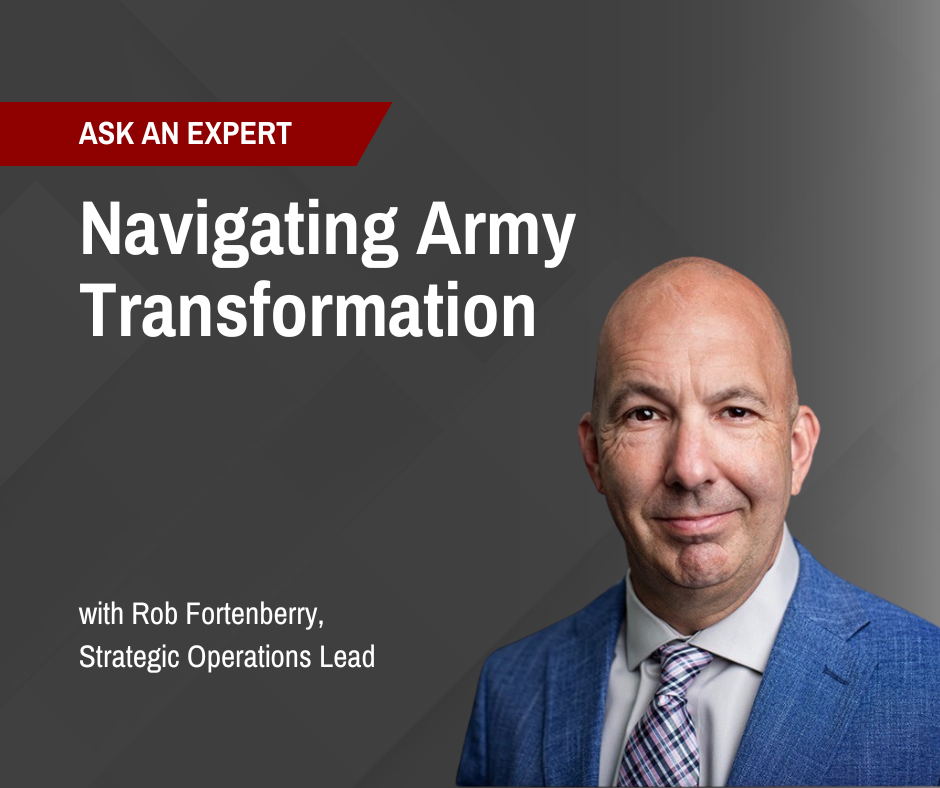
As the Army undertakes one of its most sweeping reorganizations in decades, contractors like Thompson Gray (TG) are playing a pivotal but often unseen role in maintaining continuity, driving change, and reducing friction across evolving commands. We sat down with Rob Fortenberry, Strategic Operations Lead supporting the Army’s Synthetic Training Environment Cross Functional Team (STE-CFT), to get his perspective on what’s happening behind the scenes—and how TG is delivering calm in the storm.
Q: Rob, let’s start at a high level. How is the Army Transformation Initiative (ATI) impacting your customer today?
Rob Fortenberry: In a word—uncertainty, but optimistic for the overall outcome . ATI is realigning entire commands, restructuring formations, enabling early retirements across the GS workforce to meet the requirements needed to facilitate the Army Transformation Initiatives. As structures like Army Futures Command and TRADOC merge, it’s creating a massive ripple effect. Commands are being reduced, leadership realigned, and legacy knowledge is walking out the door while potentially creating new opportunities yet to be defined.
For government teams, it’s destabilizing. For Thompson Gray, it’s an opportunity to provide something in short supply right now: predictability. Our people—especially in SME and technical roles—offer continuity, advisory expertise, technical understanding and trusted execution when the path ahead is unclear.
Q: For those less familiar, what does a SETA contractor actually do?
Fortenberry: SETA stands for Systems Engineering and Technical Assistance. It’s not just “contracting” in the traditional sense—SETA roles operate just under a GS level in terms of trust and scope. We inform decisions, manage key projects, and unburden our government teammates by executing critical tasks. We just can’t obligate funds or sign the final dotted line, but critical to enabling our government partners to achieve mission success.
At TG, we’re hired not just to fill seats but to bring deep mission understanding. That’s the value-add—dynamic, multifaceted employees who operate with the precision of government civilians and the agility of private sector experts.
Q: What’s the biggest challenge your customers face right now—and how is TG helping them through it?
Fortenberry: Flexibility. As the Army consolidates and shifts responsibilities across commands, organizations need support partners who can adjust to evolving scopes without losing momentum. Missions are being redefined in real time, and that requires people who can wear multiple hats and deliver tangible results in a complex environment.
That’s where Thompson Gray stands out. I was brought on under one work scope, but today I’m engaged in far more strategic initiatives—collaborating across military, contractor, and technology teams to help bring new training capabilities to life. It’s a testament to TG’s ability to find and place professionals who not only meet the requirement, but grow with the mission. We support our government customers in solving complex problems by being forward thinking problem solvers and driven to mission success.
Q: How is TG helping customers integrate emerging technologies—and what’s your team’s role in that?
Fortenberry: We’re supporting the development of new training solutions that leverage immersive technologies to better prepare warfighters in realistic, flexible environments. It’s part of a broader push toward modernization that prioritizes readiness and cost-effective innovation.
While TG isn’t developing the technology itself, we’re a critical link in the process—bridging the gap between government teams and industry partners, validating operational requirements, and ensuring solutions align with mission needs. That’s where TG excels: turning modernization goals into executable outcomes.
Q: Looking ahead to FY26, what should leaders be doing now to prepare—and where does TG fit in?
Fortenberry: Plan for mobility. The Army is shifting fast, especially as the new executive order formalizing ATI changes drops in August. I predict contracts will become shorter in duration and more agile—three- to five-year POPs max. Geographical locations, work scope, may change and we will be asked to do more with less in the interim as the missions evolve to support the objectives of ATI.
TG’s strength is its ability to be agile, adaptive and forward thinking in anticipating how we support our government team. Whether it’s reassigning talent across vehicles or scaling up embedded support in new regions like Austin, the company is positioned to move with the mission. And leaders should look to TG not just for execution—but for insight and solutions to unforeseen manning gaps within the ATI structural design.
Q: Final thoughts—what makes TG different from other contractors in this space?
Fortenberry: Thompson Gray doesn’t just fill roles. They find people who are mission-minded, technically fluent, and culturally attuned to the defense environment. Add in the stability of being employee-owned, and you’ve got a rare combination: a company that can weather change without losing its soul.
In uncertain times of significant transition, that matters. It shows up in how we show up—for our customers and for each other. The changes with ATI are not necessarily negative to our industry. I would offer that it will provide new opportunities to grow as long as we stay vigilant and forward thinking.
Trusted, Tested, and Ready for What’s Next
As the Army advances through ATI, the need for strategic partners who understand both the mission and the moment has never been greater. Thompson Gray’s embedded teams are delivering more than just contract support—they’re providing operational clarity, strategic foresight, and trusted leadership at every level of transformation.
Rob Fortenberry’s perspective offers a glimpse into how TG operates: with agility, depth, and a relentless focus on enabling the mission—no matter how complex or uncertain the landscape. That’s the Thompson Gray difference.
Because in times of transition, certainty is a capability. And Thompson Gray brings it every day.
Ready to Navigate What’s Next?
Whether you’re managing transformation, embedding new technologies, or preparing for future operations, Thompson Gray is ready to support your mission with trusted expertise and strategic insight. Our teams thrive in complexity—so you don’t have to.
Contact Us to learn how Thompson Gray can help your organization move forward with confidence.